
Handmade goods carry a soul that mass-produced products can’t replicate. The challenge is translating that authenticity into images that stop the scroll, build trust, and drive sales. Thoughtful product photography for artisans does more than document an item—it communicates touch, weight, scale, and time-intensive craft through light, composition, and narrative context. Whether showcasing jewelry, watches, ceramics, textiles, leatherwork, or small-batch accessories, the right visuals help customers understand value at a glance and feel confident buying online.
What Makes Artisan Product Photography Different (and More Persuasive)
Unlike commodity products, artisanal pieces thrive on subtlety: micro-textures in a hammered band, the warm patina on brass, the way light catches a hand-glazed rim, or the stitch density of a hand-loomed textile. Effective imagery must capture these nuances without distortion. That means prioritizing clarity, color fidelity, and scale cues so viewers can sense how an object might feel in the hand or look when worn. The goal isn’t just to show; it’s to translate the tactile into the visual.
Trust is central to handmade commerce. Consistent lighting and angles across listings create a cohesive gallery that signals reliability. Multiple views—front, side, close-ups, on-model or in-situ—reduce uncertainty and returns. Adding a simple lifestyle frame (a ring on a hand, a pour from a ceramic pitcher, a scarf draped on shoulders) pairs emotion with function. For jewelry and watches, on-skin imagery conveys size and proportion better than specs alone, while pristine packshots keep pages clean and shoppable.
Artisan brands also benefit from a clear visual voice. Minimal backdrops in soft neutrals let materials shine, while curated environments can place a piece in its intended world: a walnut ring box, a linen runner, a marble slab, a field-worn leather jacket. Props should be restrained and purposeful—supporting, not stealing, the spotlight. For example, a matte-grey ceramic cup often photographs best against a warm, textured linen that accentuates its form without overpowering it. Similarly, reflective products like polished metal need controlled highlights that reveal shape without harsh glare.
Pricing and perceived value correlate strongly with presentation. High-end images justify craftsmanship by conveying precision and care. Crisp edges, true whites, and accurate metals (gold vs. brass vs. bronze) tell a product truthfully. This is why artisans should consider a repeatable system—shot lists, lighting setups, and editing guidelines—to maintain consistency as collections expand, whether selling on a personal site, marketplaces, or through boutiques.
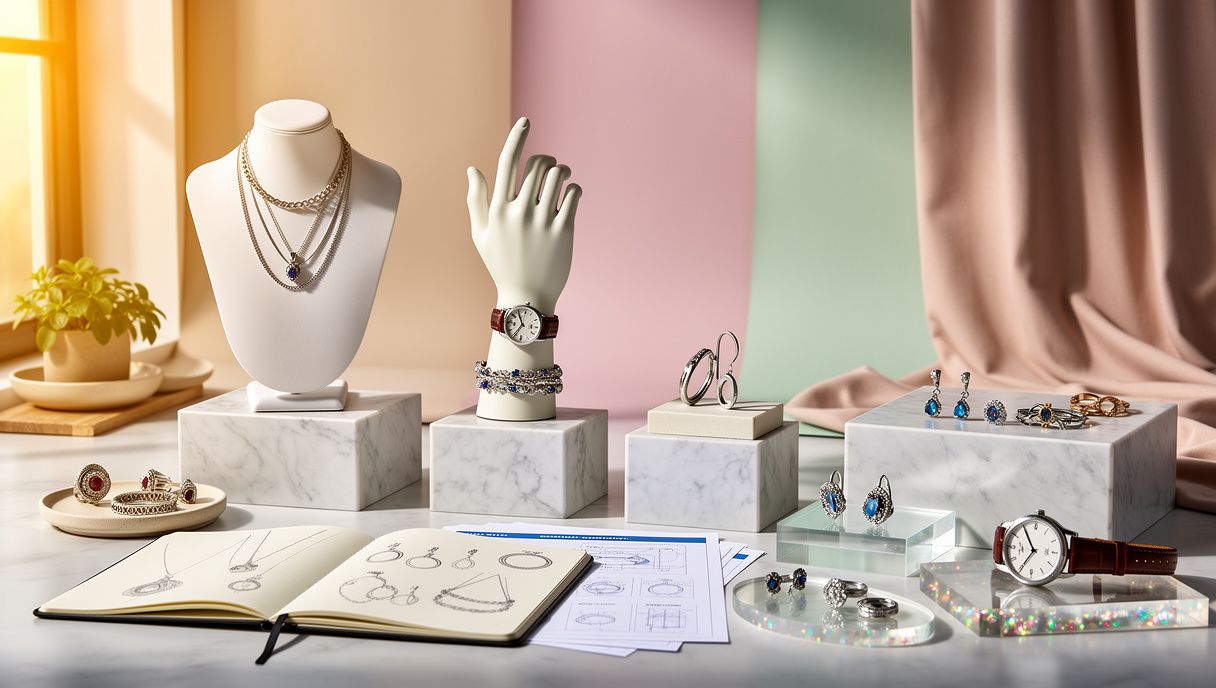
Light, Color, and Styling Techniques That Honor the Handmade
Lighting is the language of material. Soft, diffused light is a reliable base for most handcrafted goods, revealing form without crushing shadows. A large window with sheer diffusion or a softbox placed slightly off-axis produces gentle gradients across curves. Add a white reflector to lift shadows, and use a black card to sculpt definition where needed. For highly reflective items (jewelry, watches, glossy glazes), polarizing filters and larger light sources help tame specular highlights, preserving detail while keeping metal and glass lively.
Color integrity matters, especially for gemstones, textiles, and glazes. Calibrate your screen, set a custom white balance, and include a gray card in a reference frame for accurate edits. Avoid heavy filters that shift tone or saturation; the aim is a faithful, elevated representation. Keep a consistent background color across a collection to streamline catalog pages and reinforce brand identity. For jewelry photography, consider matte backgrounds that won’t reflect into stones or metals; for ceramics, textured linens or wood can add warmth and context without overwhelming the subject.
Composition should balance clarity and character. Start with hero packshots: straight-on, three-quarter, back view, and macro details. Then add “use” frames: a ring on a hand, a watch under a cuff, a mug beside a book. Always include scale cues—fingers, a coin, a ruler edge, or a simple on-model shot. Keep horizons straight and avoid over-propping. When in doubt, remove one element; the handmade piece must remain the protagonist.
Workflow efficiency protects creative energy. Build a shot list per product: essential angles, lifestyle variations, and any feature callouts. Standardize framing (e.g., generous white space, centered subject), cropping (1:1 for marketplaces, 4:5 for social, 16:9 for banners), and file naming. Capture at high resolution to enable crisp 2K and 4K outputs for web and print. Retouch gently—dust removal, minor scratch cleanup, and color correction—while preserving the “hand” of the piece. Over-smoothing can erase the very marks that make an item authentic. For artisans who photograph with smartphones, invest in a simple lighting kit, a small tripod, and a macro lens attachment; technique and light quality matter far more than the latest camera body.
From Sketch to Storefront: Scalable Visual Production for Makers
As collections grow, artisans need speed and consistency without sacrificing soul. Modern workflows blend traditional capture with digital production to meet that demand. Concept-stage visuals—generated from sketches or CAD files—help refine form and finish before a prototype exists, enabling early marketing, pre-orders, and feedback loops that reduce waste. Once samples are ready, a hybrid approach pairs studio packshots with stylized lifestyle scenes, ensuring both e-commerce clarity and campaign-level storytelling.
AI-assisted and virtual studios now make it possible to create on-model imagery, seasonal lifestyle sets, and environmental scenes without coordinating full-scale shoots. Drag-and-drop tools can match lighting to your existing catalog, place products with convincing perspective and shadows, and output consistent sets across colorways. For reflective or tiny objects like earrings and watch dials, these tools can extend depth of field, fine-tune reflections, and maintain metal realism—historically time-consuming in a live studio. The result: cohesive galleries for web, social, and print, generated faster and at lower cost, while staying true to the materials.
Consider a practical scenario: a jeweler launching a capsule of six rings in two metals. A systematized workflow might look like this—first, virtual concept images to validate designs and gauge interest; second, minimal studio packshots for each SKU in consistent light; third, on-hand lifestyle images for scale and warmth; finally, a few campaign frames with seasonal backgrounds for ads. Templates keep framing uniform across variations and ensure rapid updates when adding sizes or finishes. Because files are produced at high resolution, the same assets can serve e-commerce PDPs, marketplace listings, lookbooks, and postcards without reshoots.
For artisans selling both locally and online, this scalability opens doors: refreshed imagery for market weekends, quick turnaround for wholesale catalogs, and nimble content for social storytelling. It also levels the playing field with larger brands. Tools built specifically for high-end goods—jewelry, watches, accessories—understand the demands of metals, stones, and fine textures, delivering launch-ready images that look truly photographed. To explore an approach designed around makers and growing luxury labels, see Product photography for artisans, where sketch-to-visual pipelines, realistic packshots, on-model options, and 2K/4K outputs help translate craft into commerce with consistency and care.
Ultimately, the most effective system is the one you can sustain. Lock down light, color, and styling fundamentals; establish a repeatable process; and adopt modern tools to fill gaps—whether that’s rendering pre-production visuals, generating lifestyle variants at scale, or polishing final imagery. When every photo communicates material truth and maker intent, your products do more than look good—they feel inevitable in the customer’s life.

Lahore architect now digitizing heritage in Lisbon. Tahira writes on 3-D-printed housing, Fado music history, and cognitive ergonomics for home offices. She sketches blueprints on café napkins and bakes saffron custard tarts for neighbors.